Pathogenic: When Microbes Make You Macrosweat
I’ve been playing games since the Atari 2600 was the height of home entertainment, and I’ve seen fads come and go like so many viruses in a petri dish. Roguelikes? I remember when they were called “Rogue clones” and you had to squint at ASCII characters. So when a new roguelike twin-stick shooter lands on my desk—well, my creaky old Steam library—I approach it with the weary caution of a man who’s seen a hundred “next big things” fizzle out. Pathogenic, from Aberrant Labs and published by Slug Disco, promised a fresh angle: you play as the disease. Not the hero fighting the infection, but the infection itself. And for the first few hours, I was genuinely charmed. Then the difficulty curve hit me like a macrophage on steroids. Let’s dissect this thing.

The concept is a winner. You’re a lone pathogen—a bacterium, a parasite, a nanobot—infiltrating the human body. The visuals are a vibrant, squishy mess of cells, organelles, and bodily fluids. The soft-body physics make everything feel alive: your pathogen wobbles, enemies deform when hit, and projectiles splash with satisfying goo. It’s like playing inside a fever dream, and I mean that in the best possible way. The music, a mix of jungle and EDM, actually fits the chaotic action. I’ve heard worse soundtracks in triple-A titles.
Gameplay loop: you navigate procedurally generated rooms representing different organs—skin, intestines, stomach, liver, lungs, heart—and fight immune cells. You collect organelles (weapons, passive buffs, movement upgrades) and evolve your pathogen’s shape to accommodate more slots. The buildcraft is where Pathogenic shines. You manually place weapons and internal modules like mitochondria, connecting them in chains that create synergies. Want a flamethrower that also poisons? You can do that. Want to become a lightning god that melts everything? Possible. The sense of discovery is real: every few runs you stumble on a combo that makes you feel like a genius. One player described turning into an “electrical nuke” that sat in the middle of arenas and held down fire. I had a run where my lasers bounced off walls and filled the screen with cross-shaped death. That’s the good stuff.
But—and there’s always a but—Pathogenic suffers from the same disease that plagues many modern roguelites: terminal RNG imbalance. The first two or three levels are almost trivial. You can coast through skin and intestines with any old build. Then you hit the lungs. And the game yanks the difficulty lever so hard you’d think the dev wanted to break your controller. Enemy health spikes dramatically. New enemies appear with homing attacks, protective auras, and hitboxes that seem to extend beyond their visual model. The lungs themselves have environmental hazards—suction vents that trap you, currents that shove you into bullet patterns. It’s not a gentle ramp; it’s a cliff face.
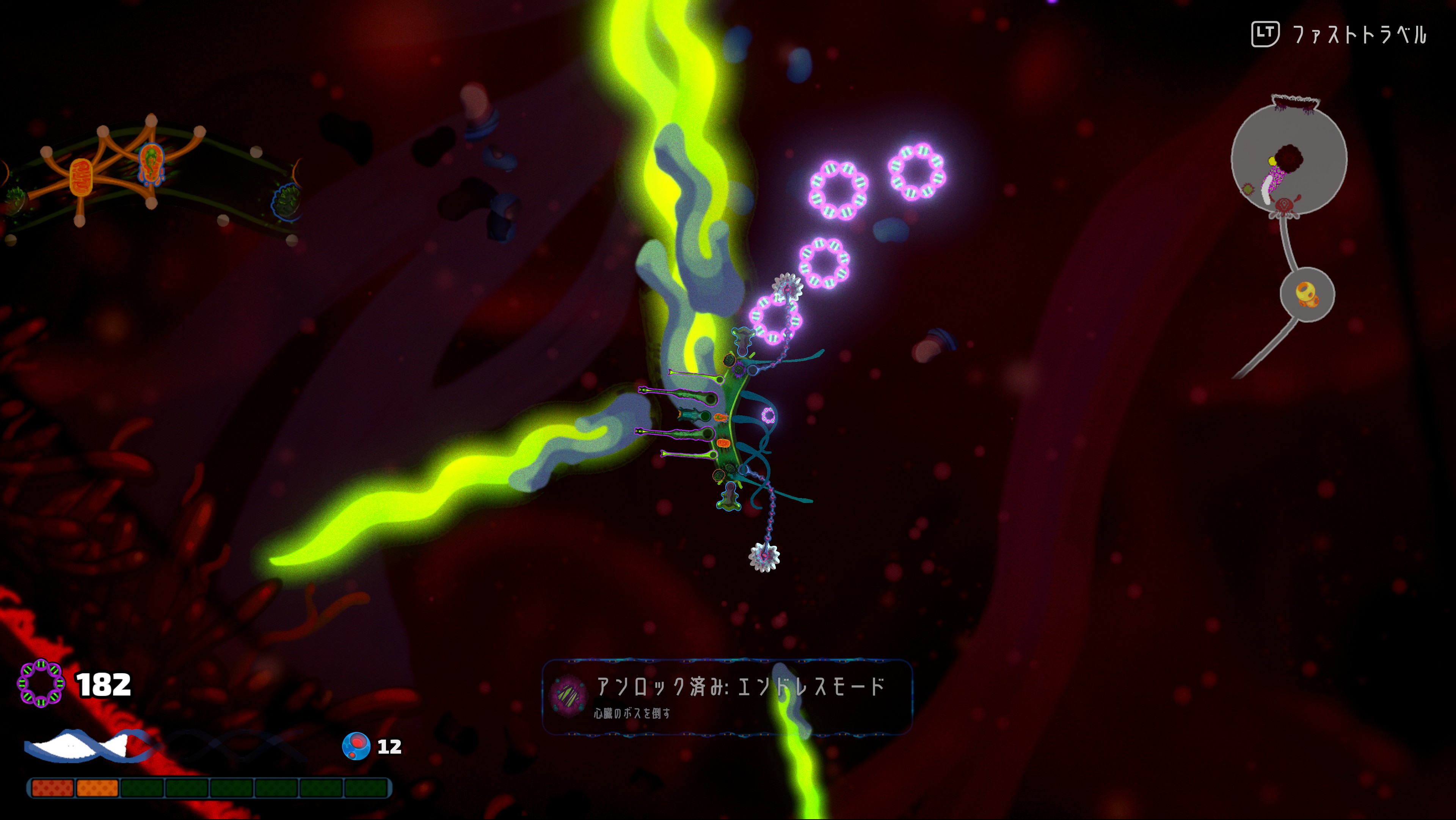
Many players have noted this. One reviewer after 24 hours had only four achievements and called the game “ridiculously brutal and kind of unfair.” Another said the RNG for level-up rewards is “blatantly unfair… like playing an old NES title that blatantly cheats.” I’ve felt that sting. You can go an entire run without seeing a single weapon upgrade, then the next run drown you in melee gear when you needed ranged. The meta-progression—unlocking permanent upgrades for each pathogen—helps, but it’s stingy. After beating the final boss once, I couldn’t afford the next upgrade. That’s not motivating; it’s grinding for grinding’s sake.
And then there are the bugs. I’ve taken damage in empty rooms. I’ve had life-saving items (the “bomb” organelles that should activate on death) simply not work. Enemies inconsistently decide whether touching them hurts you. The dodge ability sends you rocketing across the screen, often into more danger. The movement has a jell-o inertia that feels good until you need precision. In the cramped arenas of later stages, that lack of precision is fatal.
But let’s not bury the good. When Pathogenic works, it’s addictive. The “one more run” hook is strong. The variety of playable pathogens—from a simple bacterium to a modular nanobot to an amoeba that can reshape itself—offers genuine replayability. Each has its own skill tree, and you can respec freely between runs. The build depth is impressive: you’re not just picking items, you’re physically arranging them on your cell’s body, managing connections and adjacency bonuses. It scratches an itch that few games do, somewhere between The Binding of Isaac and a puzzle game.
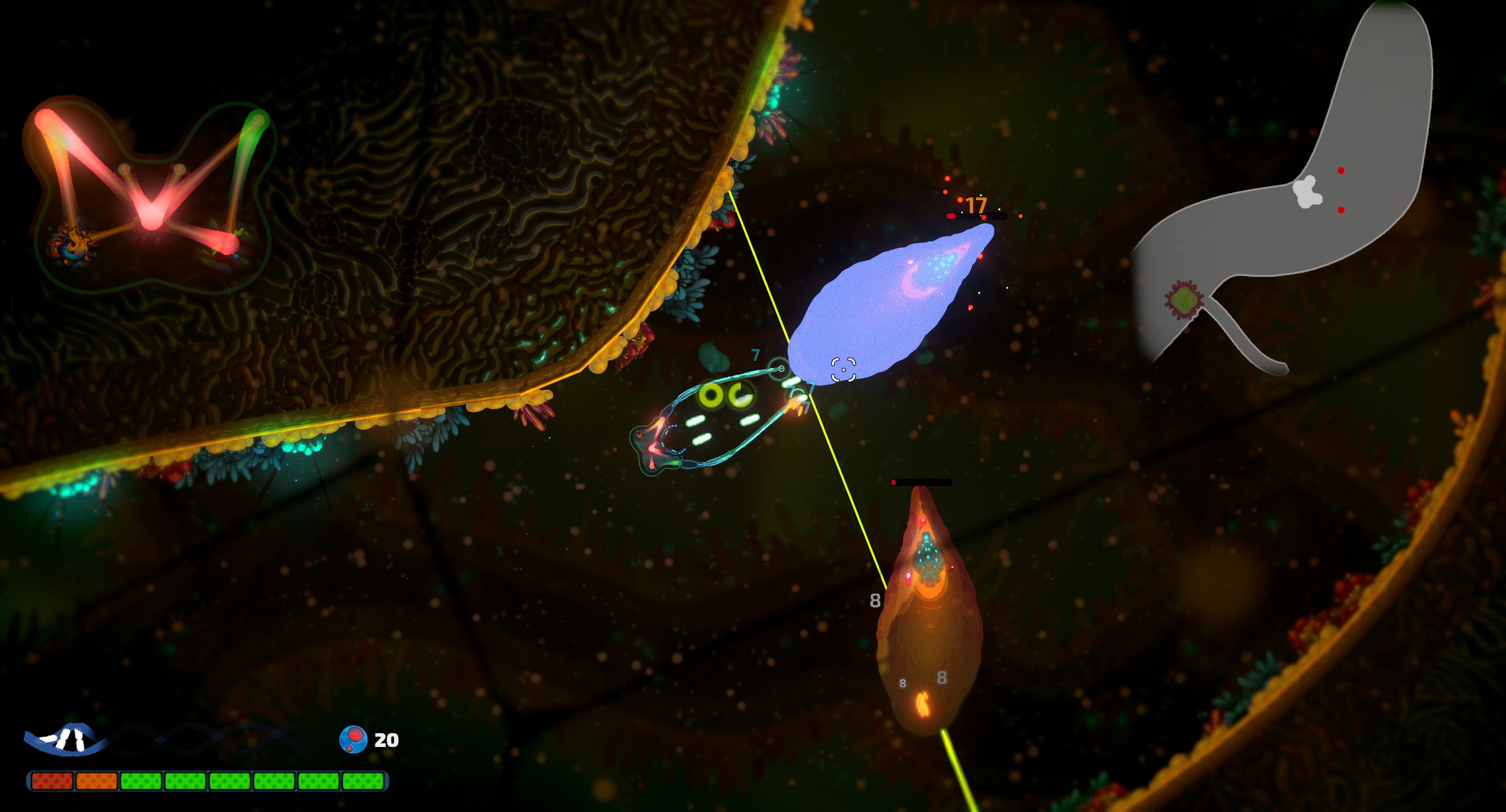
Performance is generally solid. I run on a mid-range rig from 2018, and I only saw frame drops when I deliberately created a screen-filling chain reaction of explosions. No crashes, no stutter. The devs clearly put care into the technical side. The art direction is cohesive and charming—every biome has a distinct color palette and feel. The sound design is punchy. On a pure craftsmanship level, Pathogenic is a marvel.
So why the mixed feelings? Because the balance issues turn what could be a 9/10 into a 7/10. The game punishes you for not getting lucky. In a roguelike, luck should be a seasoning, not the main ingredient. Compare to Hades, where even a bad run teaches you something and the meta-progression always feels like progress. Or Dead Cells, where the difficulty curve is smooth and the variety of biomes keeps runs fresh. Pathogenic’s later stages feel like a lottery: either you hit the jackpot and obliterate everything, or you’re stuck chipping away at bullet-sponge enemies while the environment murders you. There’s no middle ground.
Some players argue that the game is designed around “outscaling” rather than finesse. That the intended way to win is to become so overpowered that the difficulty doesn’t matter. That’s fine in theory, but when the RNG denies you the pieces for that overpowered build, the run feels wasted. And wasted runs in a roguelite are a sin. The game is also short on content—only six levels plus a secret, and the same rooms repeat. After 20 hours, you’ve seen most of what it offers. The challenge modes and daily runs extend the life, but they don’t fix the core imbalance.

I’ve read reviews that say “it’s worth the money” and I agree. For $10-15, you get a solid 30-50 hours of fun if you’re tolerant of frustration. But I can’t give it an unqualified recommendation. I’d tell a friend: “Try the demo first. If you love building broken combos and don’t mind dying to cheap shots, go for it. If you want a fair challenge that respects your time, maybe wait for a few balance patches.”
In the end, Pathogenic is like a promising indie band that released a great EP but hasn’t figured out how to fill a full album yet. The talent is there. The vision is clear. But the execution stumbles where it matters most: the grind between runs. I’ll keep it installed. I’ll probably do a few more runs, hoping for that perfect synergy that makes me feel like a god again. But I won’t be surprised when the lungs send me back to the title screen, sighing, reaching for my coffee.

Final verdict: A clever, beautiful, deeply flawed roguelite that will either hook you with its buildcraft or break you with its RNG. For the price, it’s worth a look—just don’t expect to beat it without a healthy dose of luck and patience.